A doodle is a thought taking a walk
Somewhere between a thought and a drawing, there is a doodle.
These are little things that happen when my pen starts moving before my mind has quite decided where it is going.
-
Billy Hooks went to Geometry Class
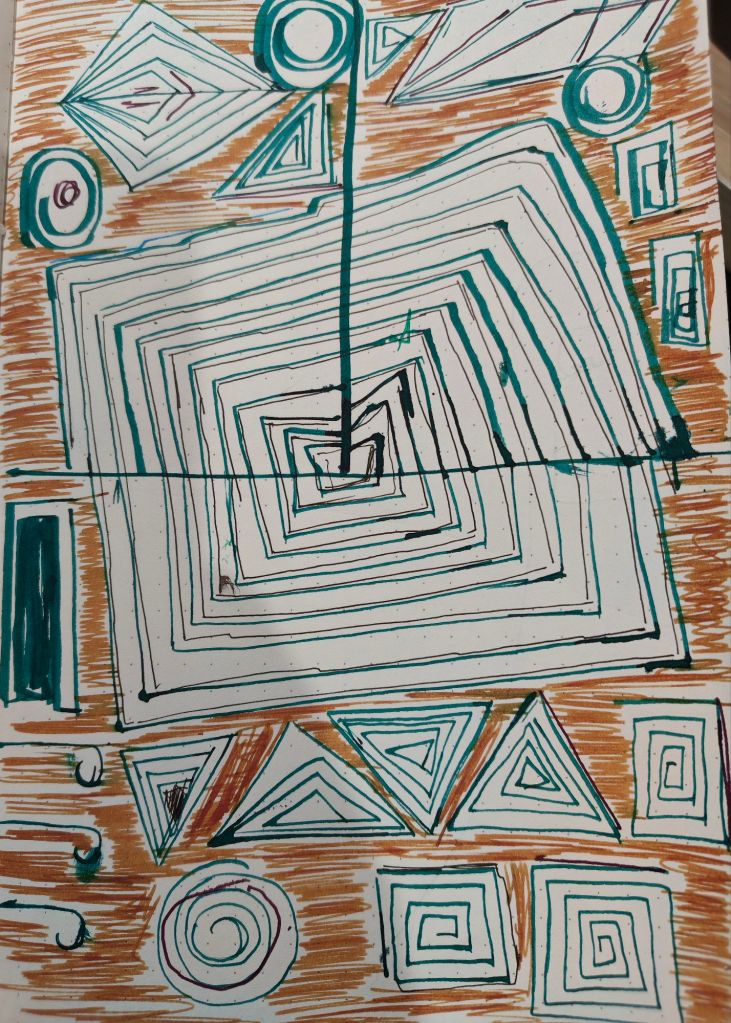
He came back with angles. I think Billy Hooks went to geometry class. Came back obsessed with circles, triangles, squares and spirals. I just let him have the page.
(more…)
-
Before I feared Sharks, I Ate Them
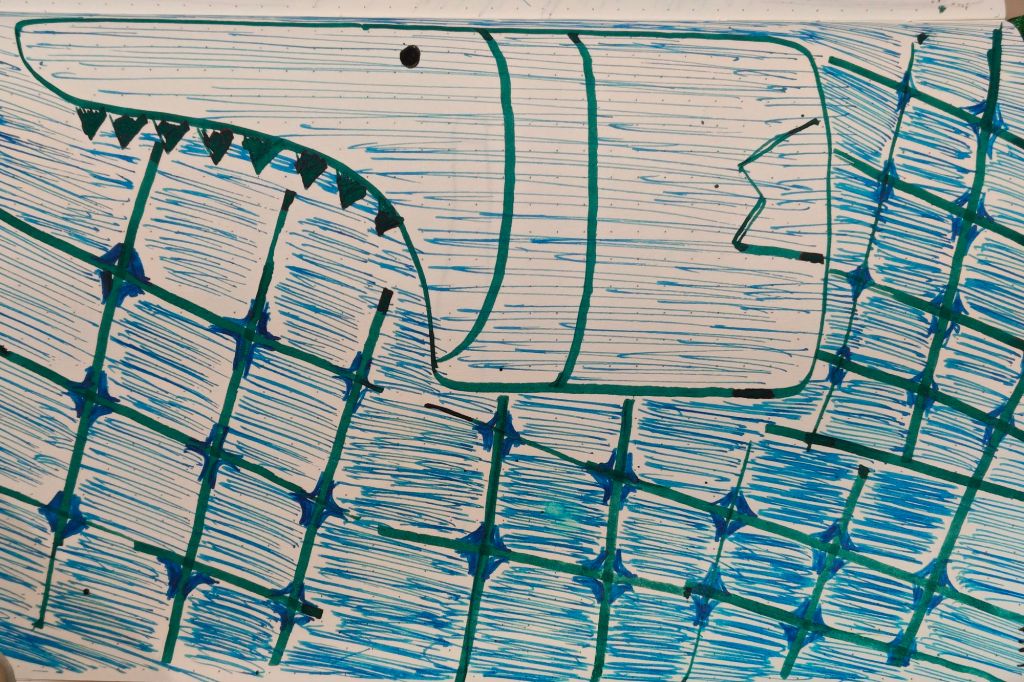
I ate shark before I ever feared one. Then Spielberg happened. Before I ever saw a shark in the water, I had already eaten one.
My maternal grandmother was a terrific cook, and in that part of the world, shark curry is something of a delicacy. It was a laborious, time consuming affair, and the smell can be strong enough for someone to politely describe the curry as “stinky.” But the taste was something else altogether. Absolutely otherworldly.
I also spent enough time in the local market to see the cadavers of sharks laid out among the day’s catch. So, growing up, a shark never really represented fear to me. It was simply a rather large fish that could, with enough effort, end up in my grandmother’s kitchen.
Then came Jaws.
And interestingly, I think the book was far more awe inspiring than the movie. The novel made the shark feel less like a movie monster and more like something vast, unknowable and genuinely terrifying. The movie gave that fear a face. The book gave it an imagination.
Suddenly, the creature that had belonged to my grandmother’s kitchen belonged to my nightmares.
And then, years later, along came Bruce in Finding Nemo, cheerfully declaring that he was on a seafood diet: “I see food, I eat it.” Apparently, sharks could have comic timing too.
So my relationship with the shark has travelled a rather strange journey: from grandmother’s curry, to the fish market, to Jaws, and finally to Bruce.
(more…)
Perhaps that is what I find most fascinating about them. The animal itself never really changed. Only the story I told myself about it did.
-
The Flood of Panic
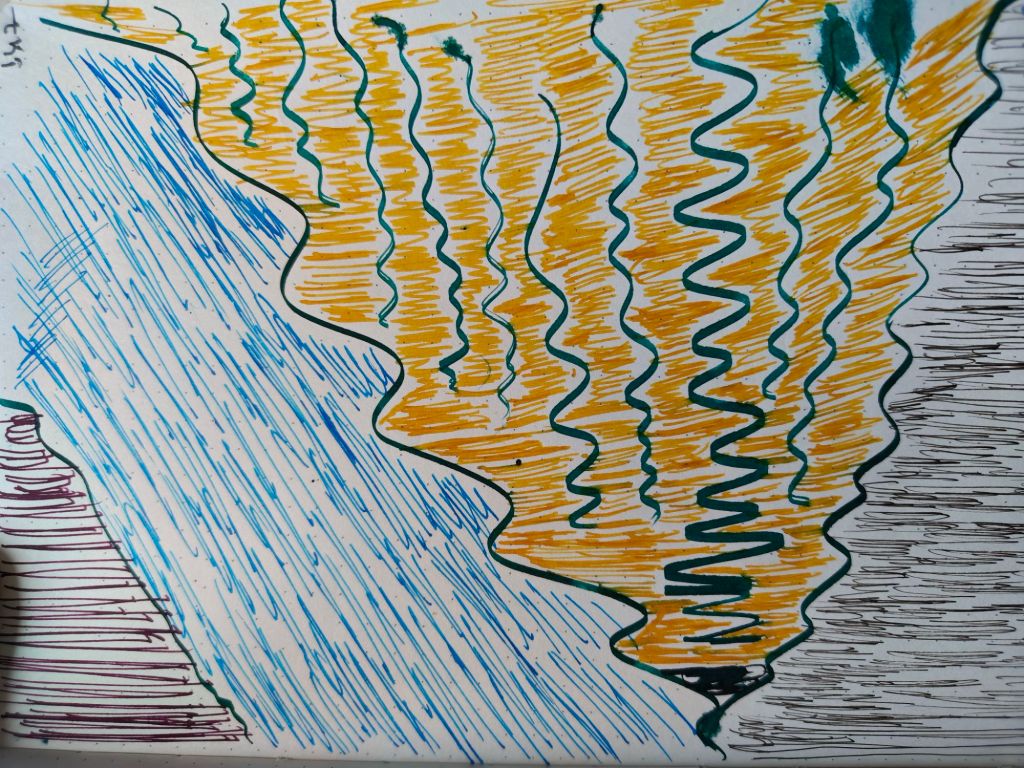
Three rivers, one uncertain journey. In December 2014, after my father’s demise, I went to Allahabad to perform his rituals at the Triveni Sangam.
(more…)
It was a biting cold morning, and we were the first to take a boat from the shore. The confluence was still some distance away, and there was practically nothing to see.
Because it was pitch dark.
The boatman was navigating towards a makeshift platform constructed from three larger boats at the Sangam. At some point, though, even he seemed unsure of where we were. The boat slowed down. There was nothing around us except darkness and the sound of the water.
And that was when my mind decided to become particularly imaginative.
I started thinking about all those stories of boats capsizing in the Ganga. People falling into the water. Bodies never being found. The possibility that this rather solemn pilgrimage could turn into something considerably more tragic.
All of this, naturally, while sitting in a small boat in the middle of the darkness.
Eventually, the boatman found his way to the Sangam.
I remember that journey far more vividly than the rituals themselves. Three rivers meeting in the darkness, and three colours are my way of putting that memory back on paper.
-
The Lighthouse
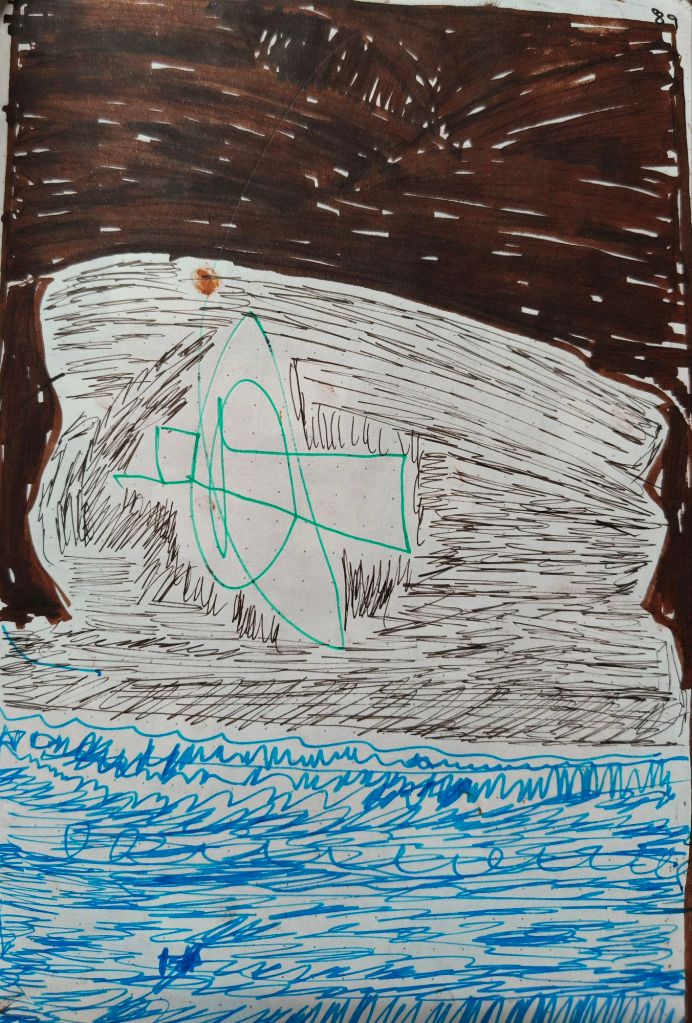
Some things only become lighthouses in retrospect. My seven year old son drew this green structure. To him, it was simply a collection of lines that presumably made perfect sense. I looked at it and decided it needed a little career guidance, so I refashioned it into a lighthouse :)
(more…)
That immediately took me back to being thirteen, when I had an intimate encounter with someone much older than me. At that age, I was far too young to understand the experience or the complicated feelings around it. Some memories, however, have a curious habit of staying around long after we have found the words for them.
-
The Sunflower I Remember
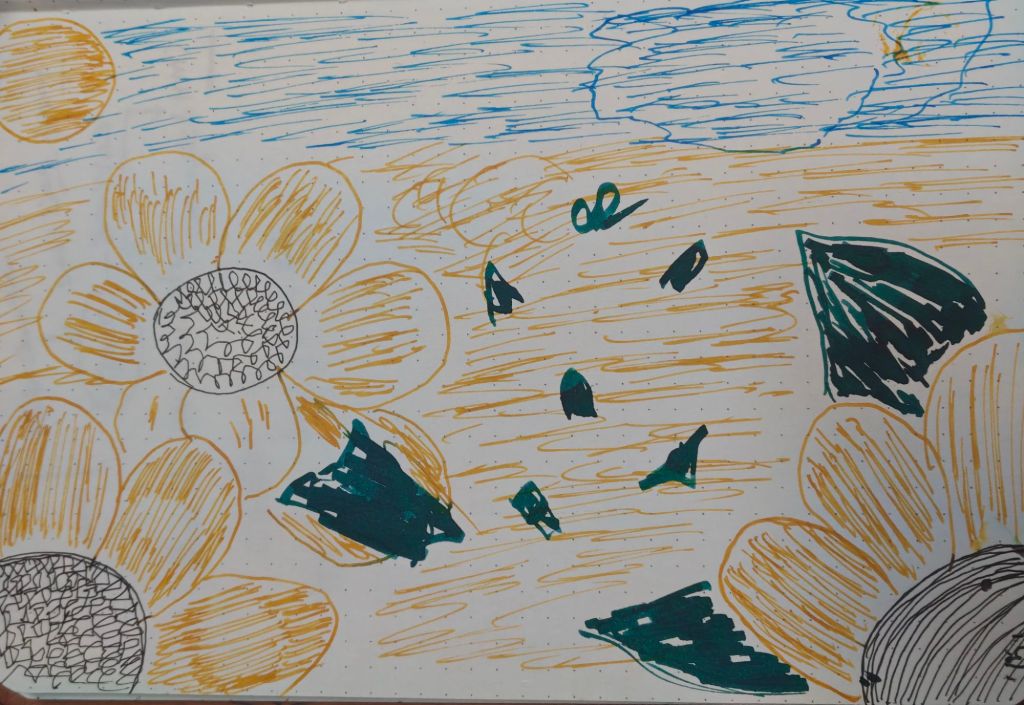
From a page in Chandamama to heliotropism, and finally to Van Gogh. Some flowers stay with you. I was probably four or five when I first encountered a sunflower. Not in a garden, but in the pages of Chandamama, the Telugu children’s monthly that somehow found its way into my father’s bookshelves. I remember being fascinated by the flower, enough for my father, a biologist, to explain to me how sunflowers turn towards the sun and how their seeds eventually give us sunflower oil. It was one of those small childhood explanations that somehow stayed.
Years later, when I studied biology as an undergraduate, I encountered the proper name for that childhood wonder: positive heliotropism. The flower I had simply known as something that followed the sun suddenly acquired a scientific vocabulary.
And then there was Van Gogh, who took my fascination with sunflowers somewhere entirely different.
(more…)
So this isn’t really an attempt to draw a sunflower as it exists in nature. It is an ode to the sunflower as I have carried it in my head since I was five: part childhood illustration, part biology lesson, part Van Gogh, and part memory.
-
I Wandered, Once Again
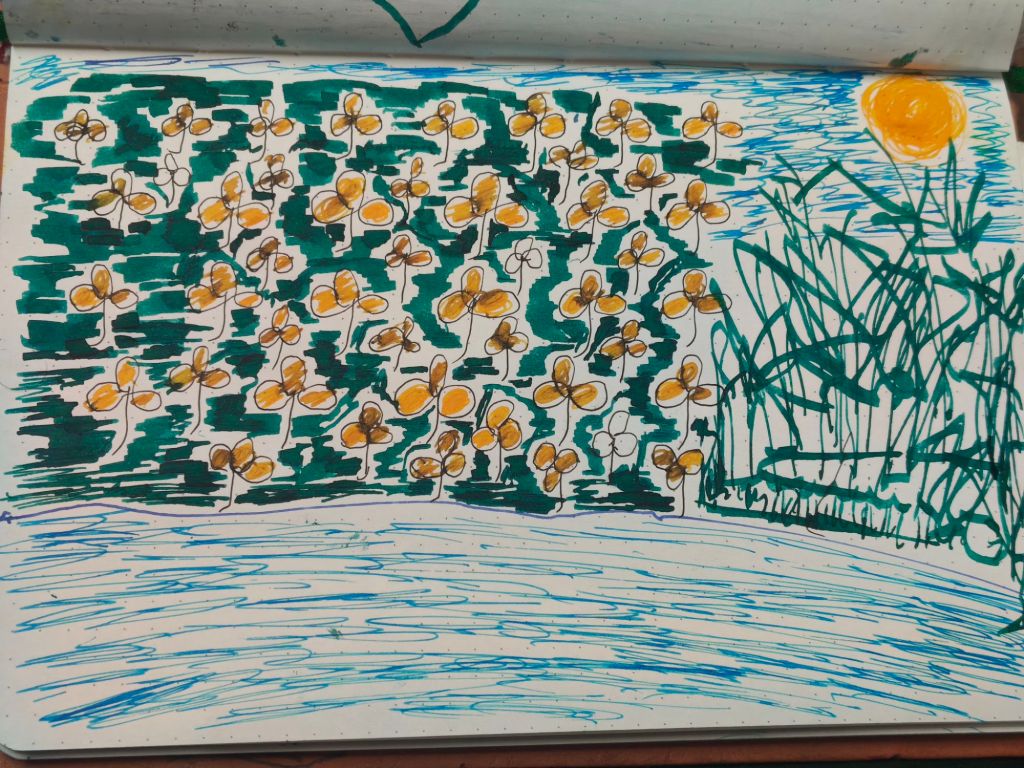
I was sixteen when Wordsworth taught me how a field of flowers could become a memory. I stumbled upon Wordsworth when I was sixteen, at that wonderfully impressionable age when I was already a romantic at heart. I Wandered Lonely as a Cloud was probably the poem that first made me curious about poetry, about how something as ordinary as a field of flowers could suddenly become an emotion you carry for years.
(more…)
Coming from a provincial town, meadows and open fields were familiar to me, even if they weren’t necessarily filled with daffodils. And perhaps that is why I have never really had a precise picture of Wordsworth’s flowers in my head. These are the daffodils I imagined at sixteen, the ones I somehow fashioned in my mind while reading the poem. I am not even sure I knew what daffodils looked like then. But in my imagination, they were always this colour, scattered across a field beside the water, glowing in the sun.
So this isn’t quite Wordsworth’s landscape. It is the landscape that Wordsworth left behind in me.
-
Through the Coconut Fronds
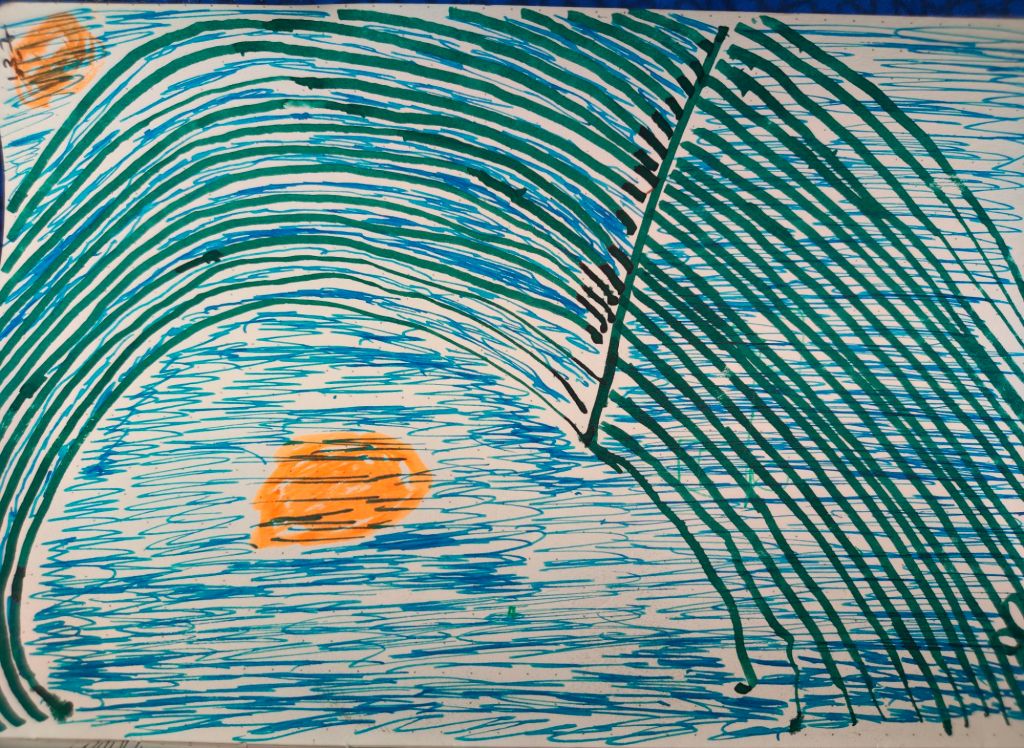
A little blue, a little green, and a sun that refused to stay inside the lines. My earliest memory of the sea goes back to a visit to Grandpa’s guest house in Vizag. I remember hearing the roar of the water from a distance, long before I could see it. Perhaps it was the distance playing tricks on me, but from where I stood, it seemed as though the sea had swallowed all the lights along the horizon. I was fascinated, though never entirely comfortable around water, a curious love tempered by a lifelong caution.
(more…)
That fascination kept finding its way back to me through books. The tropical passages in The Moon and Sixpence gave the sea an almost feverish, dreamlike quality, while Dickens could make even some distant Devonshire village or seaside hamlet feel like a place I had somehow visited before. Perhaps that is why, whenever I draw the sea, I am never quite drawing the sea itself. I am drawing the memory of hearing it before I could see it.
-
Lonely Hearts in the Dark
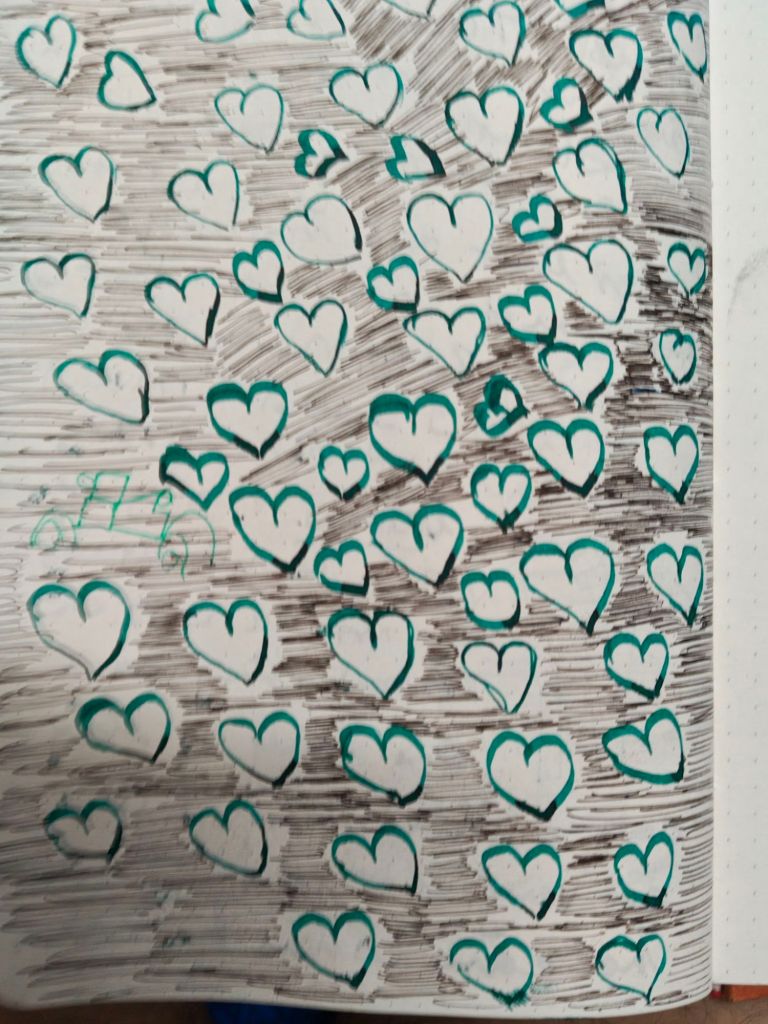
So many hearts, and somehow each one is alone. I started drawing hearts, and then they just kept appearing. Some are whole, some are awkward, some seem to be hiding in the shadows, and some look as though they are reaching for one another without quite making it.
(more…)
The dark hatching underneath them makes me think of the strange paradox of loneliness- being surrounded by countless other hearts and still feeling entirely by yourself. Perhaps that’s why I like these little ink experiments: I begin with something as simple as a heart, and somewhere along the way it acquires a life of its own.
-
The Christmas I Return To
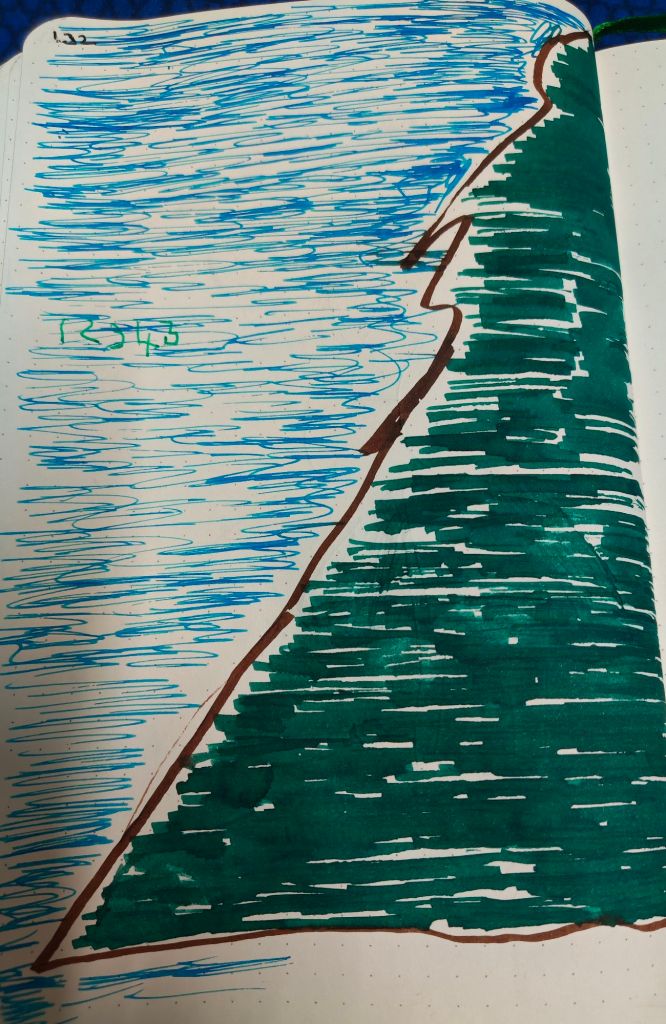
Somewhere between a winter landscape and an old Christmas story. Every Christmas, almost religiously, I return to Dickens’s A Christmas Carol. Not merely for the ghosts, the snow, or the familiar Victorian Christmas, but for what it has come to represent to me: Charity, generosity, and the possibility of becoming a little less selfish than we were yesterday.
(more…)
This doodle wandered somewhere between that memory and a frozen landscape: blue strokes like ice and winter skies, a green shape that insists on being a Christmas tree, and brown edges holding the whole thing together. Perhaps that’s what Christmas stories do too. They return every year, familiar but never quite the same, reminding us that warmth can exist even in the coldest places.
-
The Island of the Day Before – A Homage
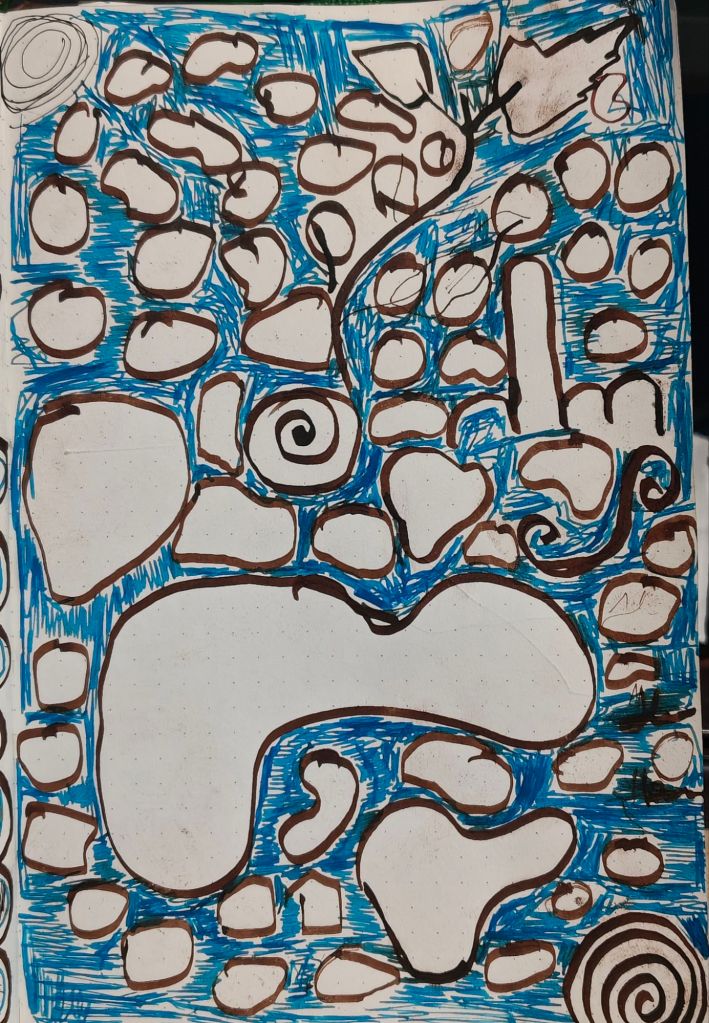
At the edge of the known world, imagination begins. While reading Umberto Eco’s The Island of the Day Before, I found myself wondering how medieval Europe imagined the world beyond its known shores. What lay beyond the edges of their maps? Strange kingdoms, mythical creatures, distant peoples, impossible islandsvor perhaps the legendary realm of Prester John? A mappa mundi was not merely a map of geography; it was also a map of what people believed, feared, imagined and hoped existed beyond the limits of what they knew.
(more…)
What fascinates me most are those blank spaces. They weren’t really empty; they were invitations to imagine. I felt something similar while reading Eco. There were large sections of the book I didn’t fully understand, yet his narration and the intrigue of the story kept pulling me onward. Perhaps I didn’t need to comprehend every layer. Some mysteries are more pleasurable when they remain mysteries.
This doodle is my little mappa mundi of that feeling: somewhere between the known and the imagined, between history and myth, with a few deliciously unexplored territories left blank.
 har-ish