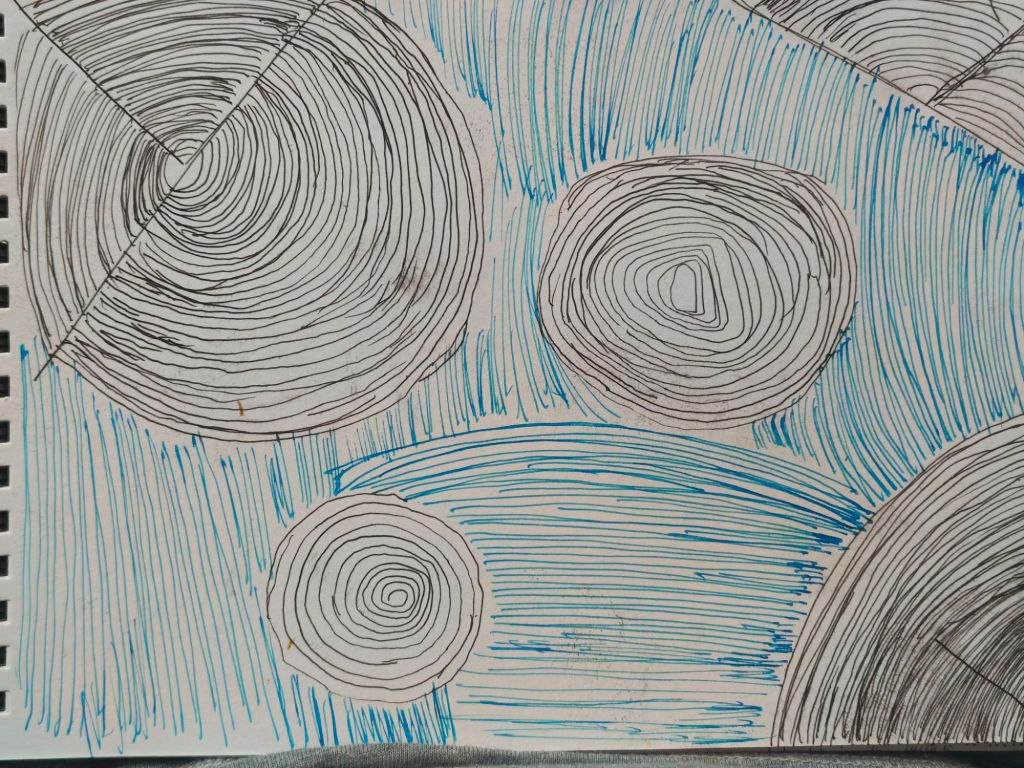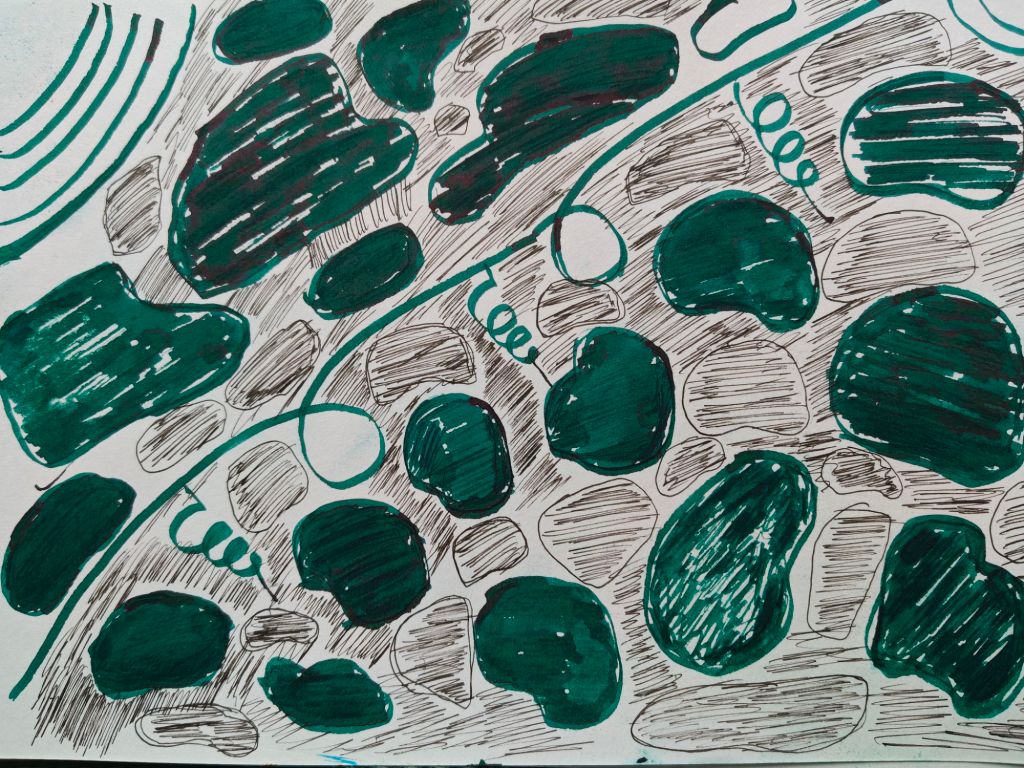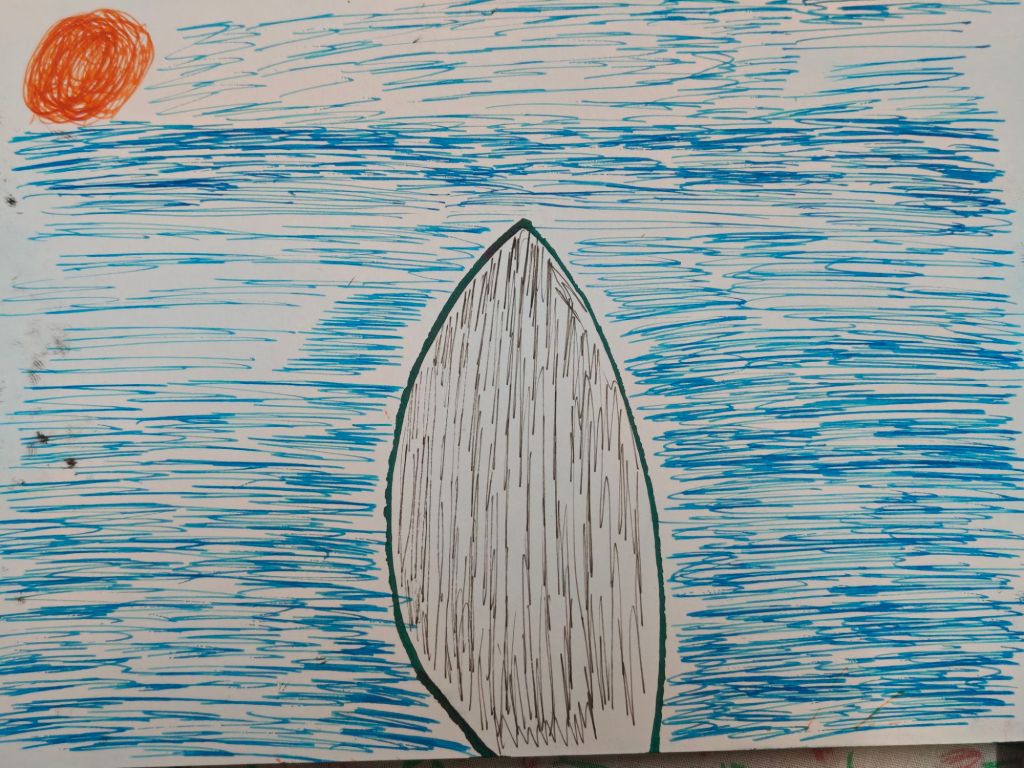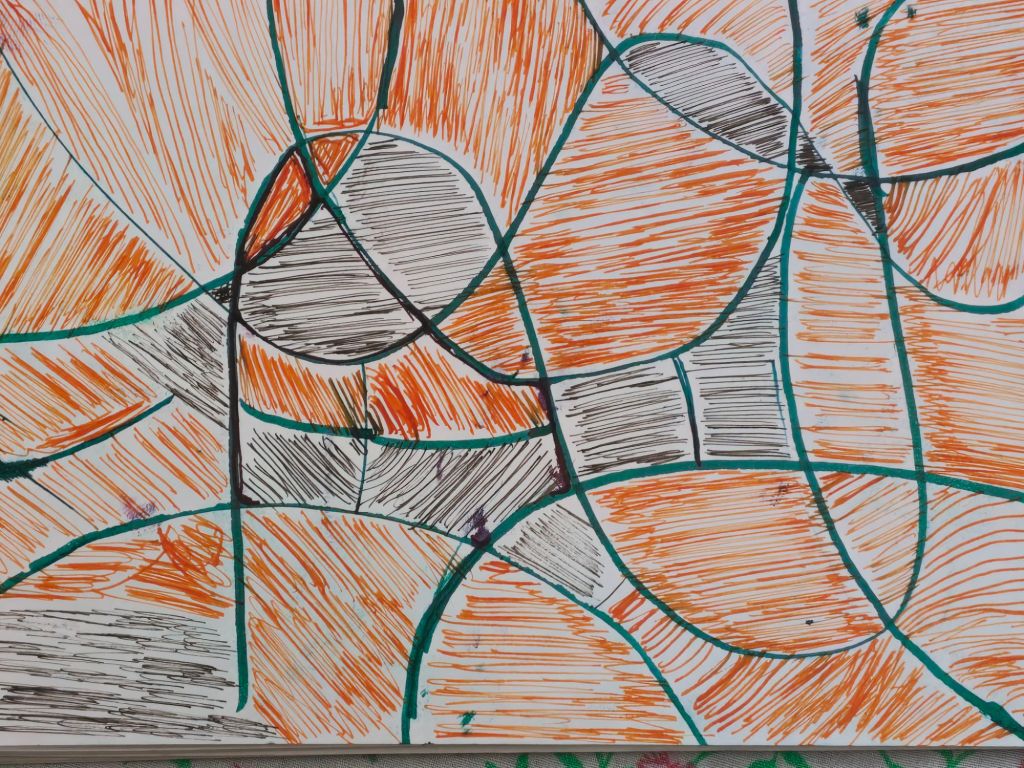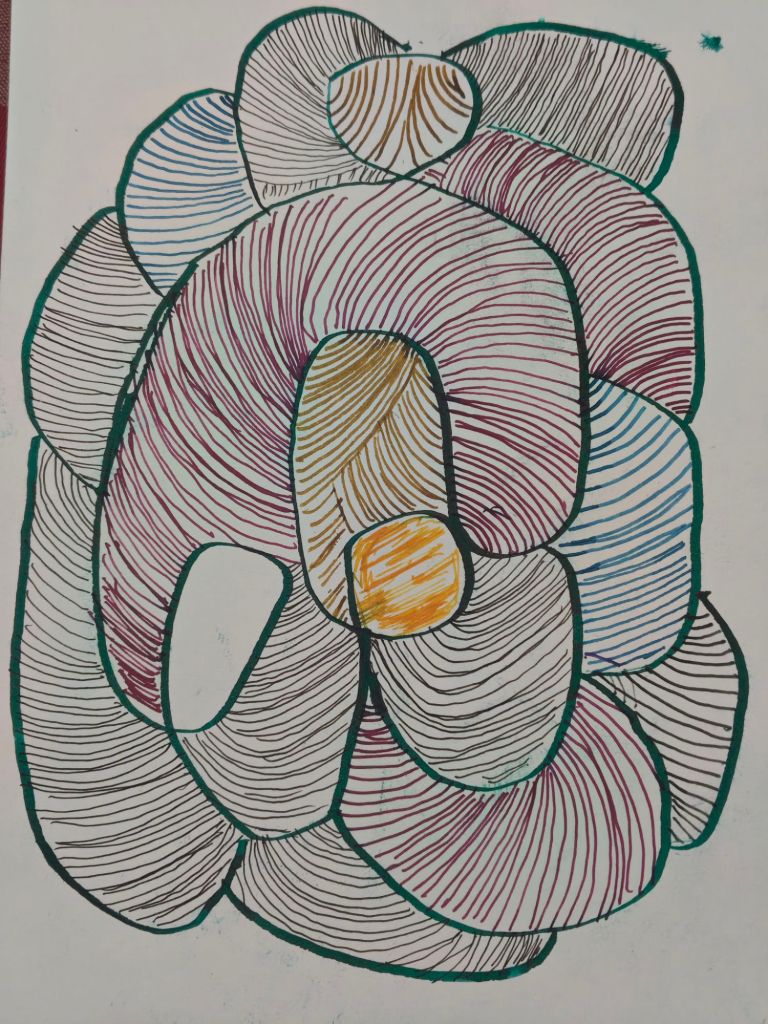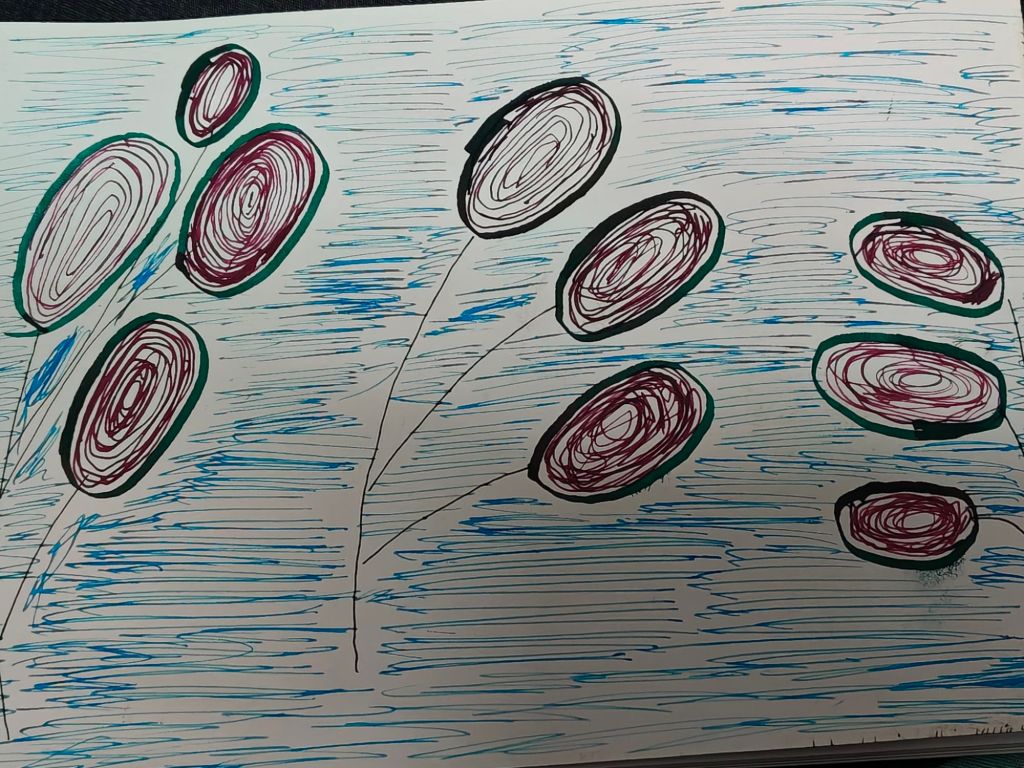
I imagined a fern meeting the river under the cover of night. Its fronds stretch toward the water as if drawn by some quiet, inexplicable longing, while the river carries on in its restless blue scribbles. There is no particular reason for their meeting, and perhaps there doesn’t need to be one. Some of the sweetest encounters happen in places where they have no business happening at all-much like a sweet encounter once upon a time in a server room. Perhaps unlikely places have a way of making certain moments all the more delicious.
Some books are meant to be understood. Others are meant to be wandered through.
I have always been drawn to books that don’t quite agree to explain themselves. They pull me in with the logic of a dream: a little magical realism, a little cyberpunk, a little speculative science, with fragments of history, mythology, technology and things that seem to have no business existing together.
I think of Kafka on the Shore, Salman Rushdie’s exuberant worlds, The Moor’s Last Sigh and The Enchantress of Florence, and Neal Stephenson’s Baroque Cycle and Cryptonomicon as books that can make me feel wonderfully clever one moment and deliciously lost the next. I follow the thread because I want to know where it leads, knowing perfectly well that some threads may never meet.
And perhaps that is the pleasure. I don’t leave having comprehended every layer; I leave exhilarated by the fragments I’ve caught, the connections I’ve imagined, and the gaps that remain gloriously open. This doodle is my little cytology of that farce; my attempt to put those fragments under a microscope, only to discover that the specimen itself keeps changing shape. We are all in a state of flux not even knowing why.
He came looking for the sea. The sea, apparently, came looking back.
Hemingway’s old man meets a slightly more bewildering version of the sea. The jagged black shoreline looks almost like a row of sharp teeth, while the enormous blue body beside it resembles a whale or perhaps a wave that has briefly taken the shape of one. The tiny figure stands between these interpretations, dwarfed by something that refuses to settle into a single form. Is he facing the ocean, a creature, a cliff, or some enormous living thing? I rather like not knowing. The sea is allowed to be a whale today.
Some pages contain ideas. This one contains sleep.
There wasn’t really an idea here. I just started drawing Zs, and eventually the page began to look like it was falling asleep. Some Zs are tiny and restless, some are enormous and stretched across the page, and some seem to have completely lost interest in the proceedings. Perhaps every page eventually gets tired of carrying our thoughts. So this one decided to take a nap.
If everything that exists had to be stitched together, perhaps this is what God would wear.
I don’t know what God’s kilt looks like, but I imagine it would have to contain a little bit of everything: stones and cells, eyes and windows, creatures and buildings, patterns and accidents, things recognisable and things that refuse to be named. This began as nothing more than an exercise in filling space a shape leading to another until the page became a strange patchwork of worlds. Somewhere along the way it started looking like a garment, and the absurd thought occurred to me: perhaps the universe itself is God’s kilt, an enormous piece of fabric stitched together from things that have no business belonging together. We spend our lives separating everything into categories; perhaps God, if there is one, simply sees the whole ridiculous thing as one piece.
A lifetime of fragments: things read, forgotten, misremembered, and rediscovered. Perhaps memory is nothing more than a library where the books refuse to stay on their shelves.
What started with the accidental tumbling of The Name of the Rose on an eventful rainy Saturday in 2008 became a lifelong fascination with Umberto Eco and his strange, magnificent universe of books, memory, signs and mysteries. This doodle is my small homage to The Mysterious Flame of Queen Loana: A world where fragments of memory float around, refusing to settle into anything quite whole. Perhaps that’s what I like about Eco: he makes the act of remembering feel like an archaeological excavation.
And then there was Baudolino, Foucault’s Pendulum, The Prague Cemetery, Numero Zero. Each book taking me somewhere I hadn’t quite known existed. I was thrilled, intrigued, occasionally chased into sadness, struck by epiphanies, made to feel gloriously dumb, and repeatedly excited by the possibility of drinking from that enormous pool of erudition. I read Eco at different ages and through different versions of myself: when I was happily single, when I was intoxicated with love, when distance from my love made me sad, and when that love eventually broke. The books changed meaning because I had changed; sometimes I understood them differently, sometimes I probably understood very little at all. But Eco remained a silent but staunch presence through all of it; a constant companion who never demanded my attention, yet was always there when I returned. Perhaps that is what a lifelong fascination really is: not something that stays unchanged, but something that keeps revealing a different face as you change.
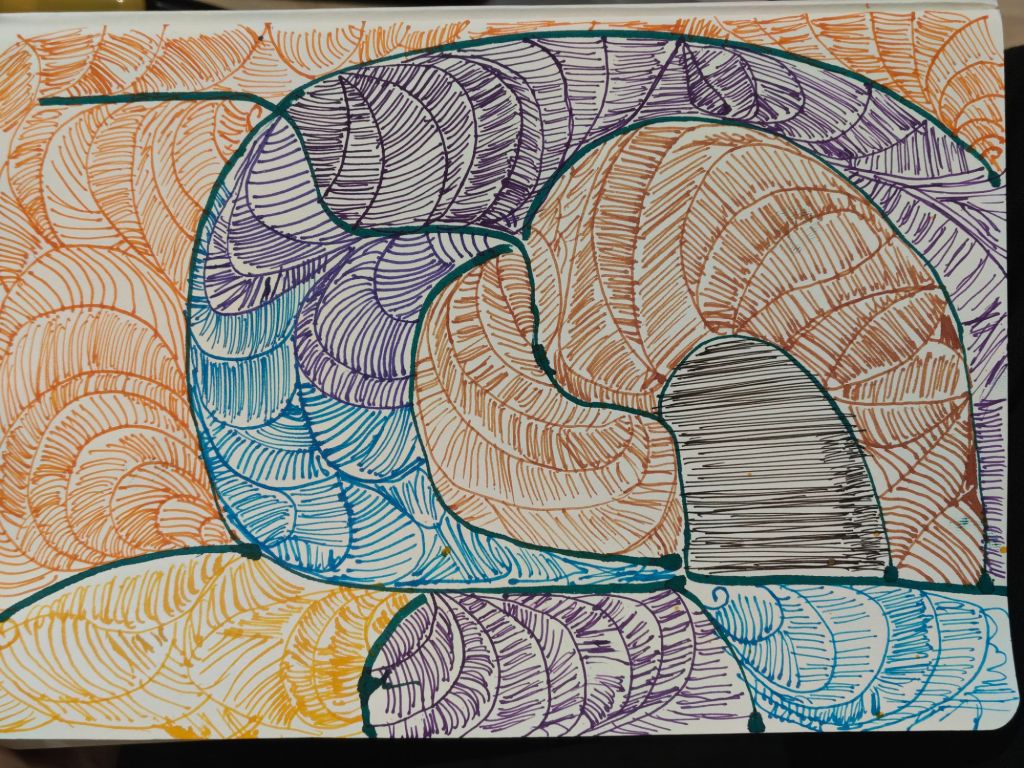
It can be a swarm of butterflies, spawn of wild mushrooms, a colony of algae, or peacock feathers. It can be all of these, but most certainly, it is none of them.
The mind does not merely see; it constructs. What we think we recognise becomes easier to recognise the next time, until interpretation begins to feel indistinguishable from fact. This is one of the great gifts of the brain: repetition can make learning, memory and habit more effortless. But the same machinery can turn a subjective impression into a conviction, and a conviction into a cage. Perhaps this is why arguments about what we “really” saw, meant or experienced are so often less about the object itself than about the private architecture each of us has built around it.
In the beginning, there was a prokaryote, darkness, and God knows what else.
Isn’t it humbling that not merely humankind, but the entire biome: Every tree, whale, mushroom, insect and us traces its improbable lineage to a microscopic particulate that didn’t even bother to enshroud its own nucleus?
Before kingdoms, consciousness, memory or meaning, there was simply matter trying to persist. A tiny membrane in an indifferent universe, floating in the primordial dark that was dividing, adapting, becoming. Perhaps all of life is just that ancient accident continuing its improbable journey, one cell at a time.
Different trajectories, different velocities, different colours: Each moving with the quiet certainty that it has a direction of its own. Yet beneath the apparent order, paths begin to converge, cross and obstruct one another. Perhaps collision is not the failure of a journey, but an inevitable consequence of everything in motion.